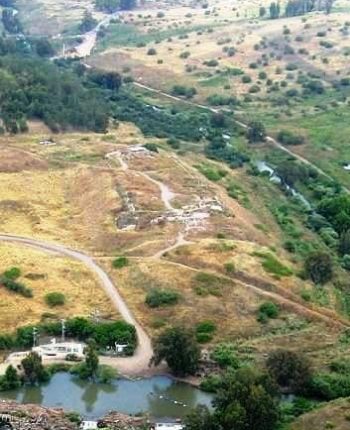
Castle Chasterlett at Jacob’s Ford
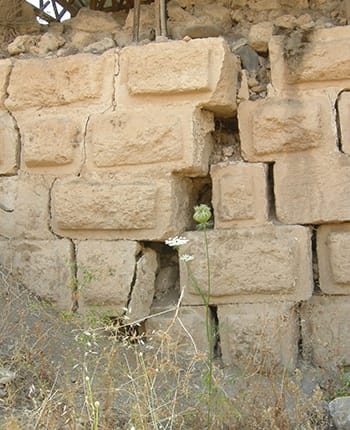

By E Kt Lt Col Ian G Harper Prov Swd B
The siege and battle of Jacob’s Ford was a victory of the Muslim sultan Salah ad-Din over the Christian King of Jerusalem, Baldwin IV.
The battle took place in August 1179 when a state-of- the art border castle was besieged and destroyed in under a week. It is now considered one of the most important of Salah ad-Din’s victories which set the conditions for him to retake Jerusalem from the Crusaders 8 years later (1187) and the re-conquest of the Holy land.
The site of the battle has remained undisturbed for nearly 800 years and only in last the few years has its significance become apparent, especially the loss of large numbers of experienced Knights Templars, bowmen and specialised builders.
The siege and battle at Jacob’s Ford which took place in under a week turned the tide of history in Outremer, and perhaps was the defining point in sealing the fate of the Knights Templar.
Salah ad-Din’s forces not only succeeded in levelling a major castle, killing the whole garrison and carting off its wealth; they crushed an army that had been considered almost invincible. The psychological and military impact must have been devastating to the Crusaders.
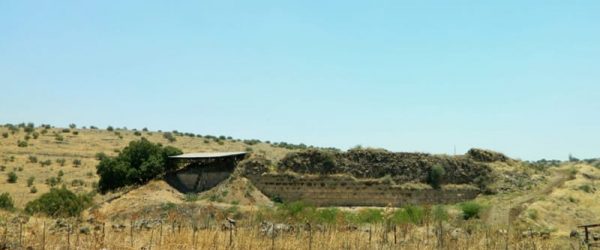
Jacob’s Ford is approximately one hundred miles north of Jerusalem on the Jordan River and was a key river crossing on one of the main access routes between Acre and Damascus, also, a historic passage point between the Golan Heights and northern Galilee.
Jacob’s Ford is also known by the Latin name of Vadum Iacob and in modern Hebrew as Ateret. Jacob’s Ford was also one of the safest crossings of the Jordan and, because of its location and importance, was utilized by Christian Palestine and Muslim Syria as a major intersection between the two civilizations.
From a Christian point of view, and that of the Knights Templars, Jacob’s Ford represented a strategic gap in the border defence of the Kingdom.
Whilst Jacob’s Ford had great importance, it must not be forgotten, this was also a religious site. William of Tyre explained that, ‘this is the place where Jacob, returning from Mesopotamia, having sent messengers to his brother and divided the people into two parts, said,
With my staff I have crossed the Jordan and now I am returning with two groups
[Genesis. 32.10]
According to Genesis 32:10 Jacob did indeed cross the Jordan at Jacob’s Ford on the way to meet his brother Esau. However, like so many other sites in the region, it also had its significance to the Muslims. There are various legends about Jacob in Islamic literature and he is discussed in the Koran.

In the twelfth century, Baldwin IV and Salah ad-Din continually contested over the area on which Jacob’s Ford was situated. As a bold strategic move and buoyed by his crushing military victory over Saladin at Montgisard (25 November 1177), Baldwin IV decided to march to Jacob’s Ford and build a defensive fortress on its territory.
The castle was intended to rival the imposing size of the Hospitallers fortress at Crac des Chevaliers, which was felt to be impregnable. Significantly Salah ad-Din viewed the threat posed by this fortification in a similar light to that of Karak in the south, where Reynald de Chatillon adopted a very aggressive policy of attacking Muslim caravans between Egypt and Damscus.
Being so close to Damascus, Salah ad-Din did not wish to have this threat so close to his seat of power. Bladwin IV and his senior military advisors theorized that this fortification could act partly as an overall defensive system protecting Jerusalem by severely inhibiting a northern invasion, whilst at the same time, acting as an offensive weapon by undermining Salah ad-Din’s security at Damascus.
The latter being about a day’s march from Jacob’s Ford. If completed, this fortress could thwart Saladin’s ambitions for an empire stretching into northern Syria and Mesopotamia. Baldwin took his new project at Jacob’s Ford exceptionally seriously, and committed practically the entire resources of his realm to its construction. This, it could be argued, represented a dramatic strategic shift in the balance of power in favour of Baldwin IV.
According to one of the versions of the Old French chronicle of Ernoul, who was a contemporary with knowledge of high politics in the Latin kingdom, Baldwin IV had agreed not to fortify the place.
However, he was persuaded by the Templars to renege on his promises. William of Tyre, notably hostile to the Templars and had a particular hatred for Odo of Saint-Amand, the reigning Templar Grand Master, nevertheless, says only that the king began to build the fortress. However, he implies that the Templars were behind it, when he states that, on completion, it ‘was surrendered to the brothers of the knights of the Temple, who laid claim to all that region for themselves by concession of the Kings’.
Between October 1178 and April 1179, Baldwin IV and the Knights Templars began the first stages of constructing his new line of defence, a fortification called Castle Chastellet at Jacob’s Ford. The Templar role was significant at this stage, which Malcolm Barber argues in his essay “Frontier Warfare in the Latin Kingdom of Jerusalem” (France, John and William Zajac. The Crusades and their Sources, pp.14-15.) that the military orders were at this time trying to impose a more coherent defensive strategy on a kingdom which up until then had been defended too incoherently by local Lords. Certainly, it was the Templars who agreed to man the castle on completion.
While construction was in progress, Salah ad-Din became fully aware of the strategic implication and problem he would have to overcome at Jacob’s Ford if he were to protect Syria and re-conquer Jerusalem. Earlier in the year, he laid the castle under siege, but having sustained notable losses, was forced to retire, realising he would need a much larger force.
Coinciding with this, the Frankish army was in disarray following setbacks from previous unsuccessful skirmishes with the Saracens with the Grand Master of the Templars (Odo of Saint-Amand) having been taken prisoner for the second time in his military career. He died in captivity a year later, refusing to be ransomed, his body later exchanged for a Muslim leader whom they had held prisoner.
Salah ad-Din’s mind was further focused by the immanent arrival of a new Crusader force under the command of Henry I of Champagne. The phrase, now or never, could not have been more relevant.
At the time, he was unable to stop the erection of Chastellet by military force because a large portion of his Army were deployed in the area of Baalbeck, northern Syria, putting down Muslim rebellions.
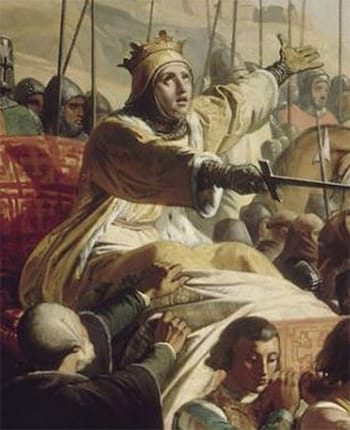
As one author writes,
Saladin was always at pains to portray himself as the champion of Islam against the European intruders, although in fact he spent much of, if not more, of his career involved in a war against…other Muslims.
Consequently, Salah ad-Din adopted an alternative and more diplomatic strategy by offering Baldwin IV 60,000 dinars to halt construction. Baldwin declined, perhaps advised by the Templars.
However, Salah ad-Din made a further offer, this time of increasing it to 100,000 dinars. Again the Christian king refused and continued to expedite the construction of Chastellet. It is worthy of note Taqi al-Din, the Sultan’s nephew, advised Saladin to use the money to equip troops instead.
By the summer of 1179, Baldwin’s forces had constructed a stone wall of massive proportions. The castle at this stage had a formidable ten-meter-high wall and a single tower, however, it was still work in progress as the defences were not complete. The castle was very well-stocked with food, which Qadi al-Fadil estimated would have lasted for several years.
Perhaps the latter description being used as propaganda of the day to raise Saladin’s status as an exceptional military leader along with the unstoppable bravery of his troops.
A Muslim scholar, Amad al-Din recorded Salah ad-Din’s reaction on first hearing of construction of the fortress,
Let them finish and we will then go and destroy it from top to bottom so that no trace of it remains.
Saladin began by ravaging the region upon which the castle depended, a tactic which suggests that the garrison was unable to prevent Muslim troops from regularly entering Frankish territory.

As was the norm, large areas were set on fire, but Saladin also sent out raiding parties to seize the harvest. Imad ad-Din says that ‘it was not long before he [Saladin] saw them return, bringing back their camels loaded with heavy sheafs; it was thus until the complete destruction of the crops’. Evidently the need to feed troops in a year of acute shortage led to a less profligate approach to the ravaging of the enemy’s lands than was normal.
In late May, he made some preliminary sorties against the castle itself to test its strength, but, according to William of Tyre, retreated when one of his more prominent emirs was killed in the fighting.

After Baldwin IV refused both financial offers to cease construction, Salah ad-Din turned his attention away from the uprisings in northern Syria and focused on Jacob’s Ford and the Castle of Chastellet. He was fully aware that any further bargaining or negotiations would only be in vain and that the more time he wasted, the more time Baldwin IV’s engineers would have to complete the massive fortification, making its destruction that much more complex and costly.
In 1179, only a few months after construction of Chastellet began, Saladin summoned a large Muslim army to march southeast towards Jacob’s Ford. The logistics and timings of this move were complex, but Salah ad-Din’s plan was bold and simple: lay siege and destroy the castle and its inhabitants before any reinforcements from Jerusalem or any of its neighbouring territories could be mobilised and deployed.
Baldwin IV, on the other hand, was situated at Tiberias, a province situated on the Sea of Galilee, approximately a half day’s march from Jacob’s Ford. If any attack were to befall the castle, reinforcements would be able to arrive relatively quickly. Moreover, the initial fortification at Jacob’s Ford, were felt to be relatively strong and able to hold out until relief could arrive in case of a siege. As one Crusader author asserts and inquisitively asks,
The siege was effectively a race, could the Muslims crack the stronghold’s defences before the Latin forces arrived?
On Friday 24th August 1179, Salah ad-Din arrived at Jacob’s Ford with numbers which leave no doubt as to the seriousness of the attack. The plain overflowed with troops, says Imad ad-Din.
The region around Safad was raided for vine-poles and other wood to support the palisades protecting the mangonels and trebuchets as well as making ladders. The outer compound was captured by the evening of the first day; Ibn al-Athir says that the troops were inspired by a person he calls ‘a man of the people, wearing a torn tunic’, who set the example by being the first to climb up onto the wall.
Following his arrival, Salah ad-Din began the siege with a full blooded assault on the barbican (a fortified outer gatehouse) at 5pm. Further, he ordered his archers to engage the defenders by firing a barrage of arrows into the castle, thus initiating the siege. The exceptionally high number of arrow heads recovered from the site 800 years later by archaeologists testify to high rate of fire inflicted on the defenders by the Muslim archers on the east and west walls.
While the archers provided very effective covering fire preventing any effective response without risk of loss of life from the Templars, specialist Muslim miners, probably from Aleppo, began digging a tunnel to breach the stone and iron walls at the north-east corner of Chastellet. The Templars at this time were probably confident their engineering skills would stand the test of a relentless trebuchet barrage and therefore only needed to sit tight for a few weeks until relieved. Instead, they heard the scrape of miners digging a tunnel.
For two days the miners dug until they produced a tunnel 20 metres (66 ft) below ground and around 2.5 metres (8 ft) wide. Once the tunnel was dug, which they thought sufficient, Saladin’s forces placed large amounts of wood throughout the tunnel and set it alight. This process, called sapping, was a method in which the tunnel’s supports were burnt away forcing the walls to eventually collapse under their own weight. In this case, the walls did not collapse as planned, because the tunnel was too narrow.
With the sapping initially failing to undermine the walls, the troops were ordered to put out the fire with buckets of water. Saladin, understanding the risks to his troops, incentivised operations paying each soldier one gold piece for every bucket they placed on the fire in tunnel. The bravery of the Muslim troops should not be underestimated as they were at very high risk of loosing their lives from very accurate Templar cross bow fire. Success came at a price as many Muslims soldiers died in this venture.
After the fire was extinguished, the miners were ordered to dig like never before to broaden the tunnel, and did so for another two days. At the same time, Baldwin IV, having learned of this attack, called for reinforcements from Jerusalem. However, communications between Baldwin IV and Chastellet were slow which meant the siege had been under way for several days before any action was taken. Time, fatally the defenders could not afford.
The Templar force inside the fortification began to reinforce the main gates around the castle. On Wednesday evening, the Muslims relit the fire in the tunnel under the castle, and by Thursday morning, the strategy of sapping proved its worth, and the walls collapsed. The breach as intended was created.
The Crusaders’ contingency and plan to reinforce the castle proved to be in vain. Six days after the siege began, Saladin and his troops forced their way into Chastellet and the fortress and after a short and very intense and bloody battle, fell to the Muslims.
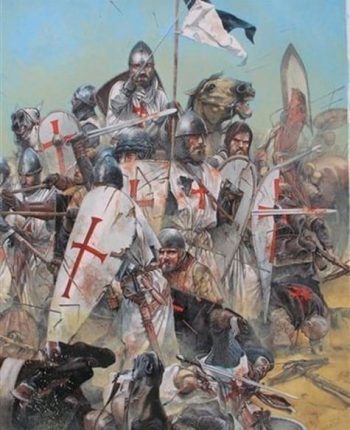
True to their Rule, The Templars did not go easily into the hands of the infidels and all died to man. In a final act of bravery, the Templar Commander mounted his warhorse and charged into the fray. Qadi al-Fadil later described how …
The prince who commanded the place witnessed its destruction and the disasters befalling his friends and companions. When the flames arrived at his side, he threw himself into a hole full of fire without fearing the flames. In burning, he was soon thrown into the other furnace {ie. Hell]
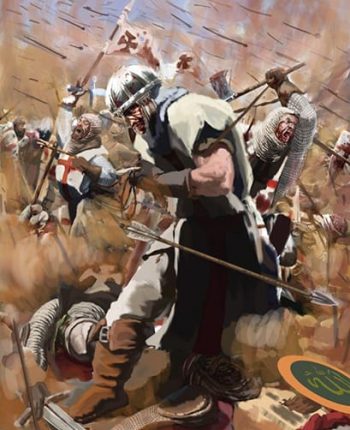
None of the Templars survived representing a significant loss of military capability and capacity on the frontier of the Levant, a loss that would take some time to recover from.
By 30 August 1179, the Muslim invaders had pillaged the castle at Jacob’s Ford and killed most of its defenders and amassing a mountain of plunder, including 1,000 coats of armour, horses an mules. On the same day, less than one week after reinforcements were called, Baldwin IV and his supporting army set out from Tiberias, only to discover smoke permeating on the horizon directly above Chastellet. They were too late to save the 800 knights, architects, and construction workers who were killed and the other 700 who were taken captive.
Many were killed en-route to the salve markets in Damascus where the remainder left alive, were sold into a lifetime of bondage. Baldwin IV and his reinforcements turned back towards Tiberias. Salah ad-Din, keeping to his word, ordered the remains of the fortification to be torn down.
Following the Muslim scorched earth approach the area remained barren and uninhabitable, made more acute by drought and poor harvest which brought the region to its knees.
Although Salah ad-Din claimed a military victory at Chastellet, his troops fell fatally victim to another enemy. Directly after the siege, the bodies of many of the 800 Crusaders, horses and mules killed at Jacob’s Ford were thrown into capacious cistern on Salah ad-Din’s orders to spoil the water and deter reconstruction on the site. The corpses in the pit began to decay in the August heat and as a result, a plague ensued, killing ten of Salah ad-Din’s key officers and making many other soldiers very sick and unable to fight.
However, this setback did not diminish Saladin’s military prowess. In 1180, Saladin and Baldwin IV signed a truce. Seven years after this peace treaty between the Muslims and the Crusaders, Salah ad-Din re-conquered Jerusalem from the Christians after the Battle of Hattin in 1187.
Some scholars suggest that, following Salah ad-Din’s victory at Jacob’s Ford in 1179, Jerusalem was extremely vulnerable to capture because the entry into the kingdom by way of the Jordan crossing immediately south of Lake Tiberias as demonstrated by its use by Saladin in 1182, 1184, and 1187 where it was virtually undefended. No castle would ever be built on this site again. However, what followed was the bleakest period of the existence of the crusader states in the whole of the twelfth century.
After the capture of Jerusalem, Salah ad-Din remained militarily and politically successful in the Near East until a military encounter with Richard the Lionheart, after which he was forced to make peace in 1192. He died the next year.
Meanwhile, King Baldwin IV, with increasing mental and physical paralysis from leprosy, died a blind and crippled man in 1185 at only twenty-three, his hopes of defending the Holy Land, like the castle, in ruins. The kingdom of Jerusalem was now vulnerable.

References:
Ellenblum, Ronnie: Frankish Rural Settlement In The Latin Kingdom Of Jerusalem. Cambridge: Cambridge University Press, 2003.
Haag Michael: The Tragedy of the Templars, the Rise and fall of the Crusader States, Profile Books Ltd, 2014.
Hill Paul: The Knights Templar at war 1120-1312, Pen and Sword Books Ltd, 2018.
Jones Dan: The Templars, the rise and fall of God’s holy warriors, CPI Group (Ltd), 2017.
Read Piers Paul: The Templars, the dramatic history of the Knights Templar, the most powerful military Order of the Crusades, Phoenix Press, 1999.
Torr Geordie: The Templars, the legend and legacy of the Warriors of God, Arcturus Publishings Ltd, 2020.