The Battle of Montgisard 1177

Templar Fighting Spirit Immortalised

By E Kt Lt Col Ian G Harper Prov Swd B

The Battle of Montgisard was fought between the Kingdom of Jerusalem and the Ayyubids Muslims under command of Saladin on 25 November 1177 at Montgisard, in the Levant between Ramala and Yibna. This sits in the period being between the Second and Third Crusades.

The Franks, at this time, were led by the 16-year-old King Baldwin IV, who was seriously afflicted by leprosy and heavily bandaged. His Christian force was heavily outnumbered when compared to Saladin’s troops in what became one of the most notable successful Crusader engagements of the Middle Ages and one where the Knights Templar’s fighting spirit, marshal discipline and gutsy heroism shone light the bright morning star.

Saladin’s army was quickly routed and pursued by the Franks for twelve miles. Saladin withdrew back to Cairo, reaching the city on 8 December, with only a tenth of the army he fielded. The loss of life, experience, weapons, treasure, horses and mules represented a strategic military and reputational disaster for Saladin and the Saracens, shifting the balance of power in the Franks favour up until Hattin.

Some Muslim historians considered Saladin’s defeat to be so severe that it was only redeemed by his victory ten years later at the Battle of Hattin in 1187, although Saladin defeated Baldwin IV in the Battle of Marj Ayyun in 1179, only to be defeated by Baldwin IV again at the Battle of Belvoir Castle in 1182.
Background

In 1177, King Baldwin IV, and Philip of Alsace who had recently arrived on pilgrimage, planned an alliance with the Byzantine Empire for a naval attack on Egypt. However, none of these grand plans came to fruition. 

Instead, Philip decided to join Raymond of Tripoli’s expedition to attack the Saracen stronghold of Hama in northern Syria. A large crusader army, the Knights Hospitaller and many Templar knights followed him. This left the Kingdom of Jerusalem with very few troops to defend its various territories.

Meanwhile, Saladin was planning his own campaign mobilising from Egypt aiming to retake the Holy City by force and set off on 18 November 1177. When he was informed of the expedition north, leaving the Holy City unprotected, he wasted no time in mobilising his forces by invading the kingdom with an army of some 30,000 men.

Learning of Saladin’s plans, Baldwin IV left Jerusalem with, according to William of Tyre, only 375 knights to attempt a defence at Ascalon. However, Baldwin was intercepted and pinned there by an advanced vanguard of troops sent by Saladin.

With Baldwin successfully fixed, Saladin left part of his army to besiege Gaza and a smaller force redeployed to reinforce the vanguard at Ascalon and marched northward with the rest.

Opposing Forces

The true numbers are impossible to estimate, since the Christian sources refer only to knights and give no account of the number of infantry and turcopoles, except that it is evident from the number of the dead and wounded that there must have been more men than the 375 knights.

However, modern historians generally deem the number of Frankish troops to have been lower; 375 knights and 80 Templars (led by the Grand Master, Odo de St Amand), for less than 500 armoured heavy cavalry, as well as between 2,500 to 4,000 infantry and archers (spearmen, swordsmen, axemen, crossbowmen and turcopoles).

It is also uncertain whether the so-called knights included mounted sergeants or squires, or whether they were true knights. On balance of probabilities and our understanding, it is likely these numbers also included mounted sergeants.

One contemporary chronicler gave a strength of 7,000 for the Latin army, while another contemporary estimate of 20,000 was probably a textual corruption of 10,000.

With a Frankish force being so small and physically deployed on open ground, could explain why Saladin did not remotely believe such a tiny force of Christians should be considered a threat.

Untitled

Confidently he marched at his leisure on Jerusalem, allowing his army to fragment and disperse out across the countryside to pillage the Kingdom’s farmlands.

Just as uncertain are the numbers of Saladin’s forces. An 1181 review listed Saladin’s Mamluk forces at 6,976 Ghulams and 1,553 Qaraghulams.

However, there would have been additional soldiers available in Syria and elsewhere, while auxiliaries might have accompanied the Mamluks.

William of Tyre reported Saladin’s strength as 26,000 (light horse), while an anonymous chronicler estimated 12,000 Turkish and 9,000 Arab troops.

Irrespective of the accuracy of the numbers, Saladin was able to deploy in the field an experienced trained force that dwarfed Baldwin’s.

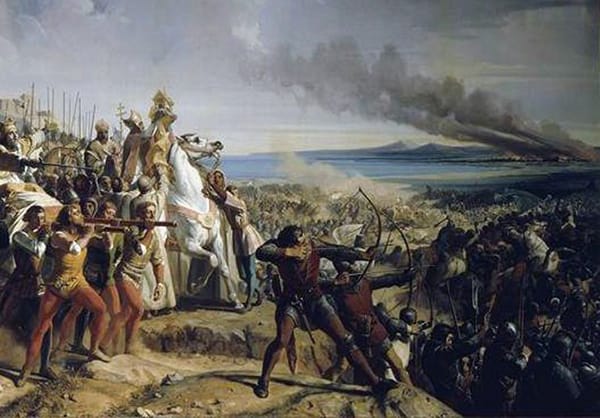
Accompanying Baldwin, who was on horseback (not on a litter as some think and depicted in the renaissance painting above) was Raynald de Châtillon, Lord of Oultrejordain, who had just been released from captivity in Aleppo in 1176. Raynald was a fierce enemy of Saladin and was King Baldwin’s second-in-command. However, due to Baldwin’s condition, the Frankish forces were physically led by Raynald.

Also with the army were Baldwin of Ibelin, his brother Balian, Reginald Grenier and Joscelin III of Edessa. With Odo de Saint-Amand, Grand Master of the Knights Templar, came with 80 Templar knights who had forced their way out of the besieged city of Gaza.

The Battle

Saladin continued his march towards Jerusalem, thinking that Baldwin would not dare to follow him with so few men at his disposal. He attacked Ramla, Lydda and Arsuf, and assessing that Baldwin was not a danger to his forces, he allowed his army to be spread out over a large area, pillaging and foraging.  

Saladin’s overconfidence about the size of his own army seems to have been part of his undoing. However, unbeknown to Saladin, the forces he had left to subdue the King had been insufficient and were overcome and now both Baldwin and the Templars, having come from Gaza, were marching to intercept him before he reached Jerusalem. Further, with his forces being widely dispersed, communication, command and control were in effect non-existent.

 The Christians, led by the 16 year old Baldwin IV, shadowed the Saracens executing a tactical sweep north along the coast then manoeuvring South-East, catching Saladin by surprise at Montgisard, near Ramla.  

The location is disputed, as Ramla was a large region that included the town under the same name. Malcolm Barber equates Montgisard with the mound of al-afiya. Saladin’s chronicler Imad ad-Din al-Isfahani refers to the battle taking place by the mound of Al-Safiya, potentially modern Tell es-Safi near the village of Menehem, not far from Ashkelon, and within the contemporary Ramla province. 

Al-Safiya means white and, indeed, the Es-Safi hill is white with the foundations of a Crusader castle recently found at the top, called Blanchegarde.

Ibn Al-Athīr, one of the Arab chroniclers, mentions that Saladin intended to lay siege to a Crusader castle in the area. But Saladin’s baggage train had been apparently become mired hindering its onward movement. The Egyptian chroniclers agree that the baggage had been delayed at a river crossing.

Saladin was taken totally by surprise. His army was in disarray. Part of it had been held up by the mired baggage train while another part of his force was widely dispersed into raiding parties across the countryside. Some men had to hurry to collect their weapons from the baggage train.

Anchoring his line on a nearby hill, Saladin’s options were limited as his cavalry was spent by the long march from Egypt and subsequent looting. Saladin’s army, was now in a state of panic but tried to regain some degree of coherence rushing to reform and make battle lines to confront the Franks.

What the Saracens also failed to realise was they had been carefully manoeuvred on to swampy ground where superior numbers acted against them. The local knowledge of the ground being likely attributed to Lord Iblin.
As Baldwin’s army looked upon Saladin’s, the King summoned the Bishop of Bethlehem to ride forward and raise aloft a piece of the True Cross. The emotional and inspirational impact of presenting the True Cross just before battle cannot be underestimated. 

The King, whose teenage body was already ravaged by aggressive leprosy, was helped from his horse and dropped to his knees before the cross. He prayed to God for victory and rose to his feet to cheers from his men, who were moved and deeply inspired by what they had just witnessed.

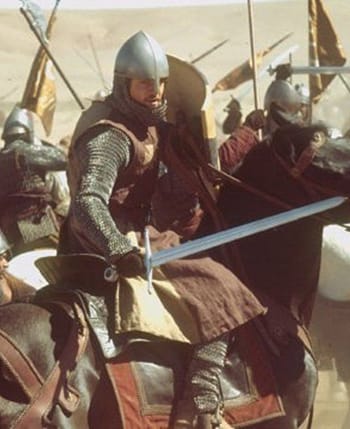
Forming for battle, Baldwin, Raynald’s Knights and the Templars, even though numerically inferior, executed a full frontal heavy armoured cavalry charge at the centre of Saladin’s hurriedly formed battle lines, immediately inflicting heavy casualties. The impact was immediate and devastating, creating a wedge, breaking the enemy formation.

Baldwin, as weakened as he was by his condition, fought right alongside his men, which, as it would for Henry V at the Battle of Agincourt in 1415, had an inspiring effect on his army.
The Franks, with the disciplined heart of the Templars, put the Ayyubids to rout, driving them from the field. They slaughtered an important number of enemies, several of whom were Saladin’s generals. Faced by the rout of his troops, Saladin found shelter in the heart of his elite guard, composed of one thousand highly disciplined Mamelukes.

The Frankish Knights, with the Templars, regrouped to charge this last line of resistance. They broke down the Muslim lines and nearly reached Saladin, who narrowly avoided being killed during the clashes by escaping on a camel. The victory was so complete that the Crusaders succeeded in capturing Saladin’s entire baggage train.

The King, fighting with bandaged hands to cover his sores, was in the thick of the fighting, further inspiring his troops. Egyptian command was under Saladin’s nephew, Taqi ad-Din. Taqi ad-Din apparently attacked the Franks while Saladin was reforming his Mamluk guard. Taqi’s son Ahmad, died in the early fighting. Saladin’s men were quickly overwhelmed. Saladin luckily, avoided capture by escaping, as Ralph de Diceto claims, on a racing camel. By nightfall, those Egyptians who accompanied Saladin had reached Caunetum Esturnellorum near the mound of Tell el-Hesi. This is about 25 miles from Ramla.

Baldwin pursued Saladin until nightfall, and then retired to Ascalon. Deluged by ten days of heavy rains and suffering the loss of roughly ninety percent of his army, including his personal bodyguard of Mamluks, Saladin fled back to Egypt, harassed by Bedouins along the way. Only one tenth of his army made it back to Egypt with him.

Aftermath

Baldwin memorialized his victory by erecting a Benedictine monastery on the battlefield, dedicated to St. Catherine of Alexandria, whose feast day fell on the day of the battle.

 However, it was a difficult victory; Roger de Moulins, Grand Master of the Knights Hospitaller, reported that 1,100 men had been killed and 750 returned home wounded. 

Meanwhile, Raymond III of Tripoli and Bohemund III of Antioch, joined Philip of Alsace in a separate expedition against Harim in Syria at the siege of Harim which lasted into 1178. Saladin’s defeat at Montgisard also prevented him from relieving his Syrian vassals.